Blog · Link building data
We vetted 31 guest post sites. Price and DR told us almost nothing.
- Sites that failed our checks cost the same as sites that passed: a median of $70 each.
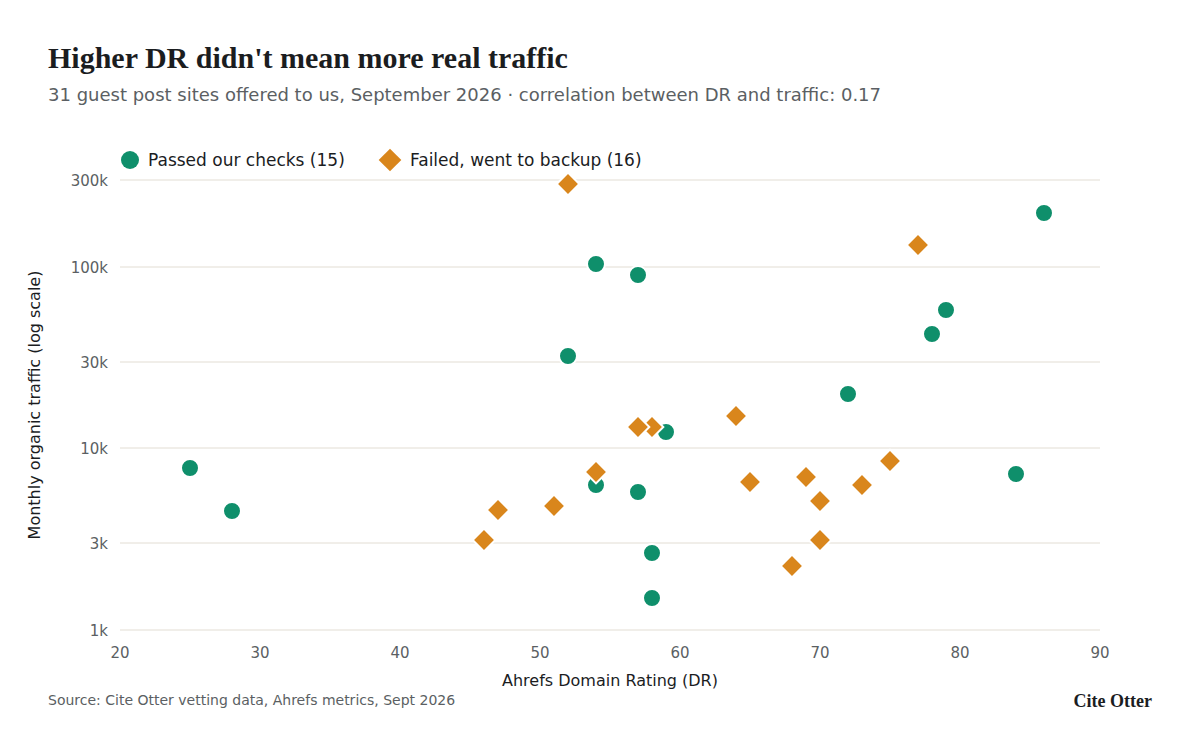
- Domain Rating barely predicted real traffic (correlation 0.17). Two sites with DR under 30 passed; half the DR 70+ sites didn't.
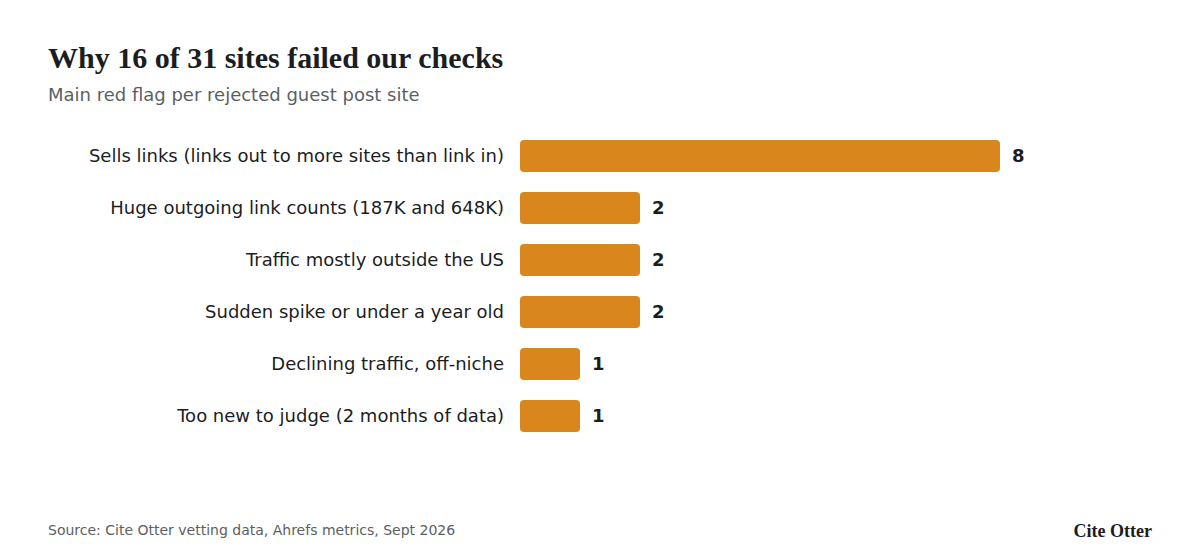
- The most common red flag: 8 of the 16 rejected sites link out to more websites than link to them.
- Traffic spikes hide problems: one site jumped from 38 to 13,027 monthly visitors in a year.
In September 2026, sellers from at least nine different outreach teams offered us guest post placements. Before putting any of them on our list, we pulled each site's numbers in Ahrefs: Domain Rating, organic traffic, traffic six and twelve months earlier, top country, referring domains and linked domains. We documented 31 sites in detail. Here's what we learned, with site names left out.
1. Price told us nothing about quality
Prices ranged from $15 to $100 per post. The median price of sites that passed our checks was $70. The median price of sites that failed was also $70. If anything, cheaper sellers listed higher-DR sites: across all 31, price and DR moved in opposite directions (correlation −0.45). Paying more didn't buy a better site.
| Result | Sites | Median price |
|---|---|---|
| Passed (active list) | 15 | $70 |
| Backup (failed one or more checks) | 16 | $70 |
2. DR is a weak shortcut for real traffic
Domain Rating measures a site's backlink strength, not its audience. Across our 31 sites, DR and monthly organic traffic were only weakly related (correlation 0.17). A DR 84 site had about 7,200 monthly visitors; a DR 52 site had over 32,000. Two sites with DR 25 and 28 passed because they had mostly-US traffic of 4,500 to 7,800 a month. Of the 10 sites with DR 70 or higher, 5 failed.
What we do instead: every tier on our price list has a minimum real traffic requirement, not just a DR number.
3. The biggest red flag: sites that link out more than they're linked to
Half of the sites we rejected (8 of 16) link out to more websites than link to them. That's a classic sign of a site that sells links to anyone, which dilutes the value of every link on it and puts it at risk with Google. Two more had 187,000 and 648,000 outgoing links.
How to check it yourself: in Ahrefs, compare "Linked domains" with "Referring domains". If linked domains are higher, be careful.
4. Traffic spikes deserve a second look
Real sites grow gradually. Among the 16 sites with 12 months of trend data, we found one that went from 38 monthly visitors to 13,027 in a year (likely an expired domain given new content) and one that went from zero to 4,802 while still under a year old. Both went to our backup list. A growth spike isn't automatically bad: three of our passing health sites grew 7 to 29 times in a year. But we flag them for content quality and recheck them before every order.
5. Check where the traffic comes from
Two high-traffic sites had India as their top market (58% and 39% of visitors). They're real sites, but a link from them does little for a US dentist or law firm. If your customers are in the US, most of the site's traffic should be too.
Our 5-point checklist
- Real traffic: at least the minimum for its tier, not just a high DR.
- Steady trend: no unexplained spikes or crashes over 6 to 12 months.
- Right country: most traffic from your target market.
- Not a link seller: linked domains lower than referring domains.
- Relevant topic: the site actually covers your niche.
Limits of this data
This is a small sample: 31 sites offered to one agency in one month, measured with Ahrefs estimates, which can differ from a site's real analytics. Seven of our passing sites passed on current data before we had pulled their traffic history; we recheck every site before each order. Treat the numbers as a field report, not a study.
Every site we offer is checked this way, and you approve each one before you pay. Buy guest posts and niche edits from $59, or get a free AI Visibility Snapshot first.